<?xml version="1.0" encoding="utf-8"?><feed xmlns="http://www.w3.org/2005/Atom" ><generator uri="https://jekyllrb.com/" version="3.10.0">Jekyll</generator><link href="https://shayandodge.com/feed.xml" rel="self" type="application/atom+xml" /><link href="https://shayandodge.com/" rel="alternate" type="text/html" /><updated>2026-08-03T15:47:34+02:00</updated><id>https://shayandodge.com/feed.xml</id><title type="html">Shayan Dodge - S.DODGE</title><subtitle>Academic portfolio of Shayan Dodge, PhD candidate in Electrical Engineering at the University of Pisa, working on Scientific Machine Learning and computational methods.</subtitle><author><name>Shayan Dodge</name><email>dodgeshayan@gmail.com</email><uri>https://destec.unipi.it/people/dodge-shayan</uri></author><entry><title type="html">STAR-PINN v1.0.0: Stacked Adaptive Residual Physics-Informed Neural Networks</title><link href="https://shayandodge.com/posts/2026/06/star-pinn-v1-0-0/" rel="alternate" type="text/html" title="STAR-PINN v1.0.0: Stacked Adaptive Residual Physics-Informed Neural Networks" /><published>2026-06-17T00:00:00+02:00</published><updated>2026-06-17T00:00:00+02:00</updated><id>https://shayandodge.com/posts/2026/06/blog-post-3</id><content type="html" xml:base="https://shayandodge.com/posts/2026/06/star-pinn-v1-0-0/"><![CDATA[<p>STAR-PINN: Stacked Adaptive Residual Physics-Informed Neural Networks. [<a href="https://github.com/ShayanDodge/star-pinn-magnetic-diffusion">GitHub</a>]</p>

<p>We are pleased to announce the public release of <strong>STAR-PINN v1.0.0</strong>, an open-source implementation of the Stacked Adaptive Residual Physics-Informed Neural Network framework for solving magnetic diffusion problems.</p>

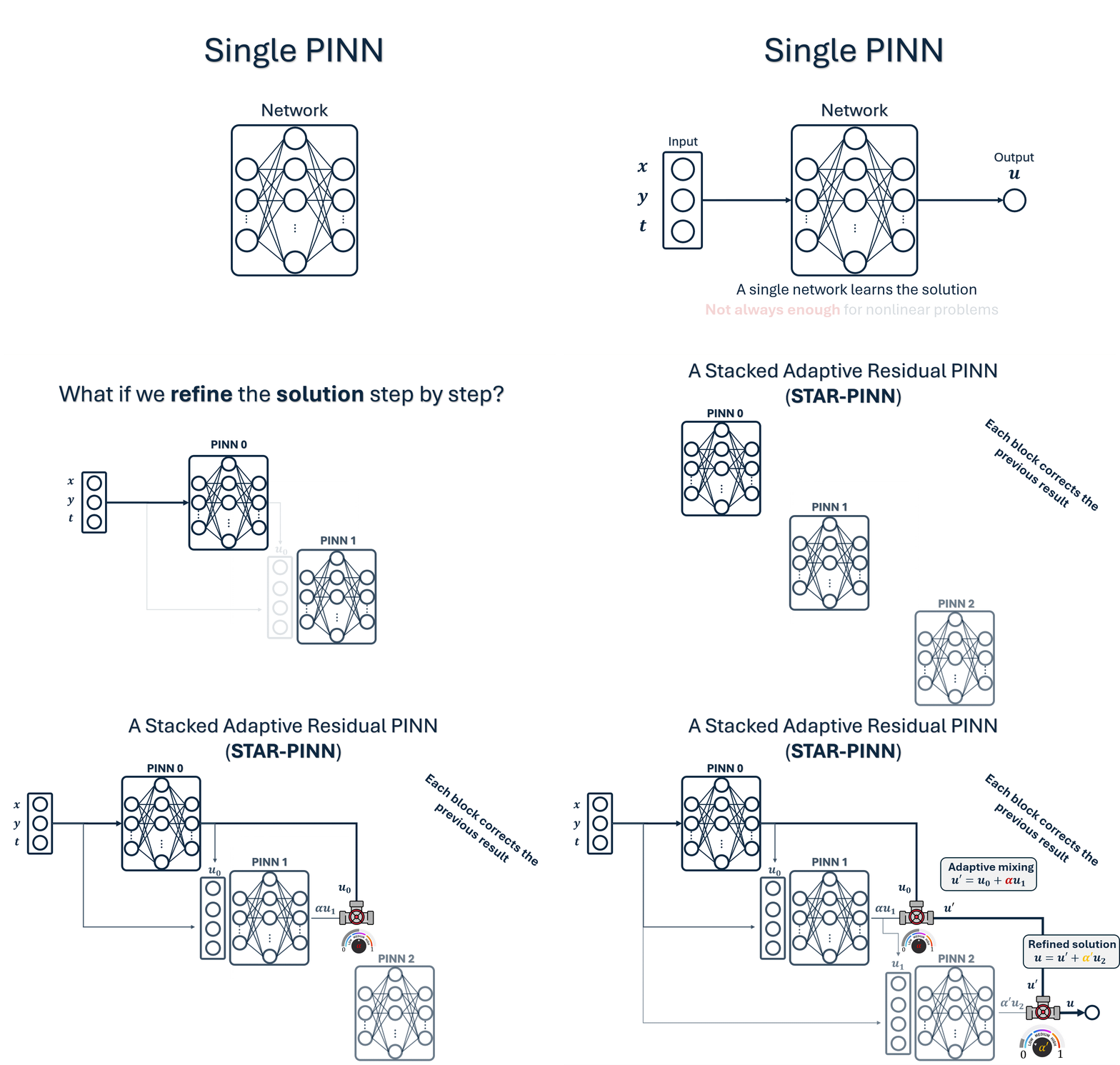
<p><img src="/images/STARPINN_V2.gif" alt="STAR-PINN Architecture" /></p>

<h3 id="core-concept">Core Concept</h3>

<p>Instead of relying on a single monolithic PINN, STAR-PINN progressively refines the solution through a sequence of residual-learning PINNs:</p>

<ul>
  <li>PINN₀ learns the initial physical solution</li>
  <li>Additional PINNs learn residual corrections</li>
  <li>Adaptive mixing progressively refines predictions</li>
  <li>Each stage improves accuracy, stability, and physical consistency</li>
</ul>

<p>This approach treats learning as an iterative physics-aware refinement process, enabling more accurate solutions for challenging electromagnetic diffusion problems.</p>

<h3 id="related-publication">Related Publication</h3>

<p>This repository accompanies our paper:</p>

<p><em>Dodge et al., “STAR-PINN: Stacked Adaptive Residual Physics-Informed Neural Networks for Magnetic Diffusion Problems”</em>, <strong>IEEE Access</strong>, 2026. [<a href="https://ieeexplore.ieee.org/abstract/document/11122441">Link</a>]</p>

<h3 id="repository-features">Repository Features</h3>

<ul>
  <li>Physics-informed deep learning framework</li>
  <li>Residual-based stacked PINN architecture</li>
  <li>Adaptive network weighting strategy</li>
  <li>Magnetic diffusion benchmarks</li>
  <li>Reproducible training and evaluation scripts</li>
  <li>Open-source implementation for research and education</li>
</ul>

<p>We hope this repository will be useful for researchers and engineers working in Scientific Machine Learning, Computational Physics, and Computational Electromagnetics.</p>

<p>Contributions, suggestions, and feedback are always welcome.</p>]]></content><author><name>Shayan Dodge</name><email>dodgeshayan@gmail.com</email><uri>https://destec.unipi.it/people/dodge-shayan</uri></author><category term="physics-informed neural networks" /><category term="pinn" /><category term="scientific machine learning" /><category term="deep learning" /><category term="computational electromagnetics" /><category term="magnetic diffusion" /><category term="open science" /><category term="scientific computing" /><summary type="html"><![CDATA[STAR-PINN: Stacked Adaptive Residual Physics-Informed Neural Networks. [GitHub]]]></summary></entry><entry><title type="html">We’ve released the code for Hybrid BEM–PINN Electromagnetics v1.0.0 on GitHub</title><link href="https://shayandodge.com/posts/2026/04/Hybrid-BEM-PINN-Electromagnetics-v1-0-0/" rel="alternate" type="text/html" title="We’ve released the code for Hybrid BEM–PINN Electromagnetics v1.0.0 on GitHub" /><published>2026-04-07T00:00:00+02:00</published><updated>2026-04-07T00:00:00+02:00</updated><id>https://shayandodge.com/posts/2026/04/blog-post-2</id><content type="html" xml:base="https://shayandodge.com/posts/2026/04/Hybrid-BEM-PINN-Electromagnetics-v1-0-0/"><![CDATA[<p>Hybrid Boundary Element–Physics-Informed Neural Network Framework for the Laplace Equation. [<a href="https://github.com/ShayanDodge/Hybrid-BEM-PINN-Electromagnetics/tree/main/Homogeneous%20L-Shaped%20Domain%20(V1.0.0)">Github</a>]</p>

<p>We are pleased to announce the release of the GitHub repository for Version v1.0.0 of the Hybrid BEM-PINN project.</p>

<p>💡 What makes this approach interesting?</p>

<p>It’s based on a 𝗱𝗼𝗺𝗮𝗶𝗻 𝗱𝗲𝗰𝗼𝗺𝗽𝗼𝘀𝗶𝘁𝗶𝗼𝗻 𝘀𝘁𝗿𝗮𝘁𝗲𝗴𝘆:</p>

<p>Instead of choosing between:</p>

<ul>
  <li>traditional numerical methods</li>
  <li>or neural networks</li>
</ul>

<p>We combine both — each where it works best:</p>

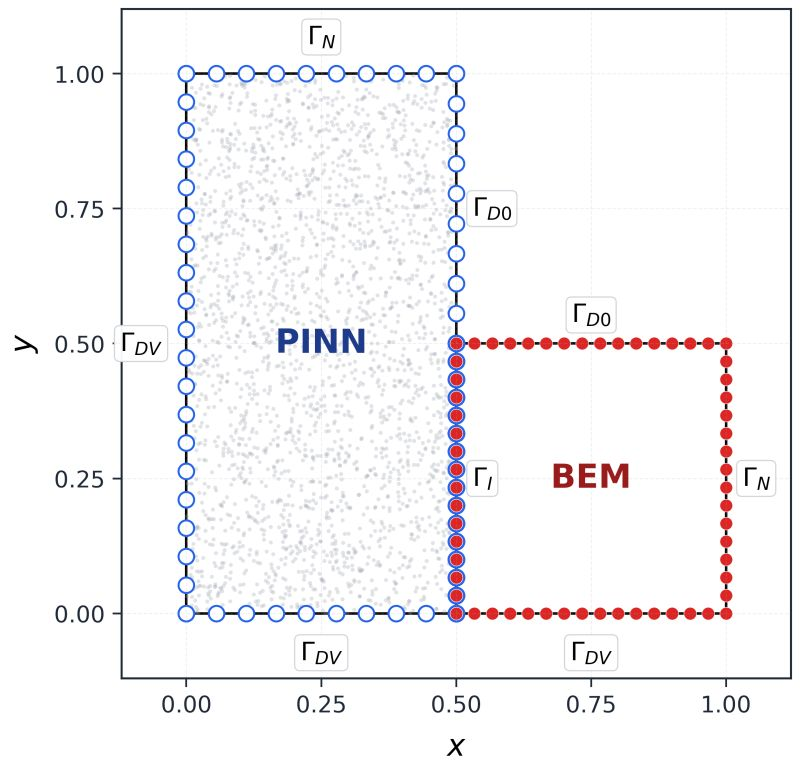
<p>🔵 Physics-Informed Neural Networks (𝗣𝗜𝗡𝗡) → learn the solution in the most relevant regions of the domain</p>

<p>🔴 Boundary Element Method (𝗕𝗘𝗠) → focuses on boundary interactions, avoiding full-domain computation in less critical regions</p>

<p><img src="/images/bempinn1.png" alt="STAR-PINN Architecture" /></p>

<p>This implementation reproduces and extends the methodology presented in:</p>

<p>Barmada, Dodge et al., <em>A Novel Hybrid Boundary Element—Physics Informed Neural Network Method for Numerical Solutions in Electromagnetics</em>,
  IEEE ACCESS, 2024. [<a href="https://ieeexplore.ieee.org/abstract/document/10755077">Link</a>]</p>

<p>🔜 More advanced versions (complex geometries, improved coupling) are coming soon.</p>]]></content><author><name>Shayan Dodge</name><email>dodgeshayan@gmail.com</email><uri>https://destec.unipi.it/people/dodge-shayan</uri></author><category term="Electromagnetics" /><category term="ComputationalPhysics" /><category term="PhysicsInformedNN" /><category term="BoundaryElementMethod" /><category term="research" /><category term="open science" /><summary type="html"><![CDATA[Hybrid Boundary Element–Physics-Informed Neural Network Framework for the Laplace Equation. [Github]]]></summary></entry><entry><title type="html">FELINES v1.0.0 is now live</title><link href="https://shayandodge.com/posts/2026/03/felines-v1-0-0/" rel="alternate" type="text/html" title="FELINES v1.0.0 is now live" /><published>2026-03-20T00:00:00+01:00</published><updated>2026-03-20T00:00:00+01:00</updated><id>https://shayandodge.com/posts/2026/03/blog-post-1</id><content type="html" xml:base="https://shayandodge.com/posts/2026/03/felines-v1-0-0/"><![CDATA[<p>Lightning Geolocation &amp; Peak Current Estimation. [<a href="https://github.com/ShayanDodge/FELINES-Lightning-Forecast/tree/main/Phase%201%20%E2%80%94%20Lightning%20Geolocation%20and%20Peak%20Current%20Estimation">Github</a>]</p>

<p>We are pleased to announce the release of the GitHub repository for Version v1.0.0 of the FELINES project.</p>

<p>This version focuss on:</p>

<ul>
  <li>Lightning strike geolocation (x, y estimation)</li>
  <li>Channel-base peak current regression</li>
  <li>Deep learning–based modeling of lightning-induced voltages on overhead transmission lines</li>
  <li>Induced Voltage Waveforms → {Strike Location (x, y), Peak Current}</li>
</ul>

<p>This implementation reproduces and extends the methodology presented in:</p>

<p>𝘋𝘰𝘥𝘨𝘦 𝘦𝘵 𝘢𝘭., <em>𝘈 𝘥𝘦𝘦𝘱 𝘭𝘦𝘢𝘳𝘯𝘪𝘯𝘨 𝘣𝘢𝘴𝘦𝘥 𝘭𝘪𝘨𝘩𝘵𝘯𝘪𝘯𝘨 𝘭𝘰𝘤𝘢𝘵𝘪𝘰𝘯 𝘴𝘺𝘴𝘵𝘦𝘮</em>,
  𝘌𝘭𝘦𝘤𝘵𝘳𝘪𝘤 𝘗𝘰𝘸𝘦𝘳 𝘚𝘺𝘴𝘵𝘦𝘮𝘴 𝘙𝘦𝘴𝘦𝘢𝘳𝘤𝘩, 2025. [<a href="https://scholar.google.com/citations?view_op=view_citation&amp;hl=en&amp;user=1usufq0AAAAJ&amp;citation_for_view=1usufq0AAAAJ:9yKSN-GCB0IC">Link</a>]</p>

<p>🔜 𝘝𝘦𝘳𝘴𝘪𝘰𝘯 𝘷2.0.0 will be released soon, expanding the project toward early-stage classification and protection-oriented applications.</p>]]></content><author><name>Shayan Dodge</name><email>dodgeshayan@gmail.com</email><uri>https://destec.unipi.it/people/dodge-shayan</uri></author><category term="lightning" /><category term="power systems" /><category term="deep learning" /><category term="machine learning" /><category term="research" /><category term="open science" /><summary type="html"><![CDATA[Lightning Geolocation &amp; Peak Current Estimation. [Github]]]></summary></entry></feed>